Episode Transcript
The Finance Ghost: Welcome to this episode of the Ghost Stories podcast. It's the end of the year. It's time for a well-deserved break, I think. But it's also a very important time because you need to make sure you don't create serious problems for yourself by the end of January.
And, of course, there's the tax-free savings accounts (TFSAs) to think about, because that deadline is in February, which at this point is now only a few months away.
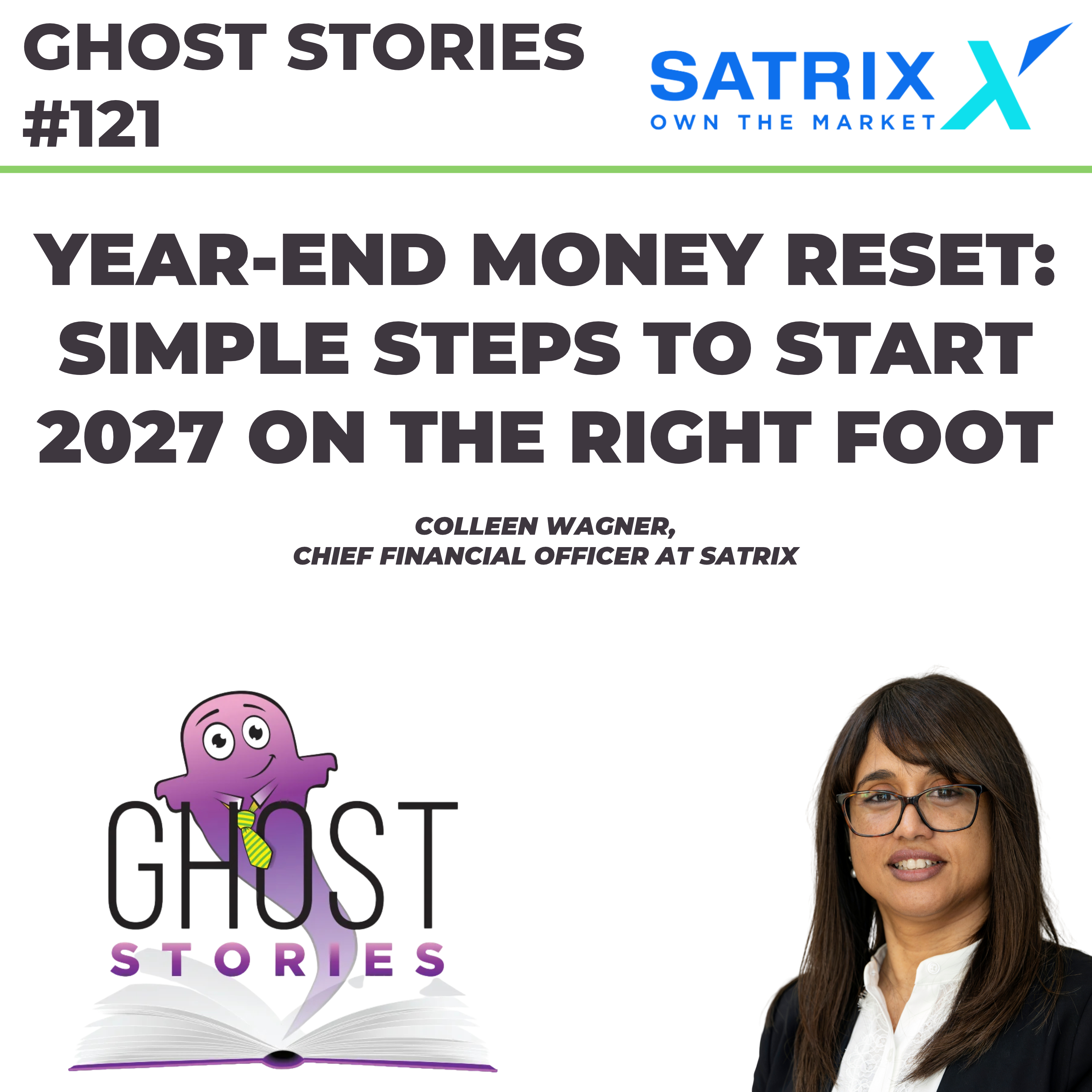
Now, a lot of people will wait until the new year to actually start thinking about their financial plans and strategies. Colleen Wagner of Satrix reckons we should be doing it a lot earlier than that.
Today we'll be talking about a year-end money reset – a more proactive approach than just sitting around and waiting for those January debit orders to humble you. No one wants that.
And if Colleen's name sounds familiar to you, it's because she actually joined us earlier this year for her podcast debut, and it was such a good one. It was about how decision fatigue impacts your financial decisions. Really powerful show that also hit home for me personally, so I'd recommend you go check it out if you haven't listened to it.
I'm expecting another good one today, Colleen, so no pressure!
Before I formally welcome you, let me just remind listeners that these really are just general strategies that we're talking about today. You must, of course, always speak to a financial advisor. Get some tailored advice for your specific circumstances.
So, with that out of the way, welcome, Colleen. Thanks for making the time.
Colleen Wagner: Thanks for having me, Ghost.
The Finance Ghost: So, last time you were on the show, we spoke about decision fatigue. I'm not sure about you, but I feel even more tired now than I did when we did that show several months ago.
It’s a time of the year where it feels like even eight hours of sleep is not going to get anyone through. It's quite hard to be in money-reset mode this late in the year, but it’s still quite important to just try to actually go through that thought process.
So, what would you say the starting point of a money reset should actually be, at this time of year specifically?
Colleen Wagner: So, Ghost, before we get into it, let me just make an important caveat. I'm not giving financial advice today. I'm sharing some general principles and a few things that I personally find useful. We all have different financial circumstances, goals and appetites for risk, so personal financial decisions are best discussed with an appropriately qualified financial advisor.
When we get to the end of the year, most of us are tired, like you mentioned earlier, so the last thing you need is a complicated financial plan. You've got to keep it simple and start with a financial stocktake.
I personally start with three broad questions. 1) What do I owe? 2) Do I have enough of a cash buffer if something unexpected happens? And 3) what expenses do I already know are coming in Jan and Feb?
Jan has a habit of being very expensive. School costs, annual subscriptions and premium increases, and debit orders all tend to arrive at the same time, often just after the additional spending that comes with December.
And if you're fortunate enough to receive a year-end bonus, I would say resist the temptation to immediately think of it as extra spending money. Take a moment and ask, “Where can this money make the most difference for me?”
It could be paying down expensive debt, strengthening your emergency fund, or putting money aside now for the costs that you know are coming.
The objective isn't to make significant amounts of difficult financial decisions when you're already so exhausted and spread so thin. It's to make two or three really good decisions, in the right order, so that you go into the new year feeling more financially prepared and in control.
The Finance Ghost: Yeah, I'm hearing a lot of really useful stuff there. Keeping it simple, I think, is particularly important. We all make that joke about it being the 500th of January, but it really does feel that way by the time you get to the end of the month [laughing]. It can get pretty rough.
What I'm really hearing from you, if I summarise all of that, is that you just need to actually be quite organised in terms of knowing what spending is coming. You don't have to get it exactly right, but you need to know that this is a time of year where you're buying gifts. You're going to probably be entertaining the kids more while they're on holiday, if you are a parent. It's all that kind of stuff, right?
It's actually just sitting down and going through the process of thinking it through. It's not about getting it 100% right. It's about just getting a vague answer that is at least directionally correct.
Colleen Wagner: That's absolutely right, Ghost.
The Finance Ghost: So let's talk bonuses, because you've referenced it there. I want to just dig into that, because something that came through really strongly in the show that we did about decision fatigue was the importance of paying yourself first. I know it's the most clichéd thing in the entire world, but it's a cliché for a reason.
And if we really understand that concept, it means making sure that when you do your monthly budget and your salary, you're leaving enough there that you are actually moving forward in life before you start spending on all your stuff.
Because the alternative is to spend first and see what's left to invest, and that does not end well. And actually, we can all be guilty of that – finance professionals included. It's not a guarantee that you don't fall into that trap just because you have fancy letters after your name.
Perhaps you can just give us your thoughts here on people living bonus to bonus as opposed to salary to salary? I mean, that's quite a risky way to go about things, right?
Colleen Wagner: So in my opinion, yes. I think the important word here is ‘bonus’. It's extra income. So, ideally your day-to-day financial plan shouldn't rely on it. I'm a big believer in building your financial habits around your regular monthly salary because that's predictable. You get that every month.
And like you said earlier, pay yourself first. Automate your savings or investments and treat them like any other monthly commitment.
It means that you're putting the money aside before you get the chance to spend it, rather than reaching the end of the month and then deciding what (or if anything) is left to save. And when a bonus comes along, you can deal with it separately.
Everybody's financial circumstances are different, so what makes sense will depend on where you are financially at the time. Some of it could go towards debt, some into investments, and some towards something you genuinely want to enjoy.
I think the problem comes when your lifestyle starts growing around bonus income that may not arrive every year. Build good habits with your salary and let the bonus give you a bit more room to move.
The Finance Ghost: Yeah, I tend to agree. I think that is a really good way to actually approach this thing. The other thing that I want to talk about - because after January comes February - and what does February mean? Well, a bunch of things, but one of the things it means is that it's your TFSA deadline.
Such a good incentive from government to actually encourage savings. You’ve got R46k to play with every year between March and February of the following year.
And for sure, contributing to something like that should be part of a broader plan you might have in place with your advisor. But again, it's quite easy to fall behind on contributions, as life tends to throw all its joys at you.
So, from your perspective particularly, Colleen, are TFSA contributions part of your plan? And what strategy do you use to make sure you actually hit your specific targets every year? Which may not be to maximise it necessarily – everyone's different – but just to meet your specific targets.
Colleen Wagner: So, tax-free investing definitely forms part of my own financial planning. And for me, the trick is not to think about February at all. It's about spreading your yearly contribution across each month.
So, your R46,000 limit works out to roughly R3,800 per month.
I like that approach because it removes another decision from my life. I decide upfront that that is what I'm going to be investing into my TFSA, and that becomes part of my routine. Then all I need to do is check in periodically to see whether I'm on track or not.
Of course, that's simply how I approach it. Each person will have to decide whether maximising a tax-free allowance makes sense for them. And it will depend on their own cash flow, debt, emergency savings, and what the broader financial plan is.
But I do think there's a useful principle here: If something is important to your financial plan, automating and planning for it can make it much easier to stay consistent.
The Finance Ghost: So, give us an example of some of these automations before we move on. How do you actually go about doing this on a monthly basis? Is it as easy as just saying, “Well, I have a rand amount and that's it. Off it goes as a debit order,” or is there more to it?
Colleen Wagner: For me, it's as easy as that, Ghost. Like I said, the R46,000 annual limit works out to about R3,833 a month, and it's as easy as setting that up as a debit order.
The Finance Ghost: I enjoy the fact that you know the number offhand. That tells me that you are very familiar with that debit order going off your account every month, Colleen [laughing].
Colleen Wagner: [laughing]
The Finance Ghost: Either that or your maths is very quick. It's definitely one of the two.
Colleen Wagner: The maths is mathing today [laughing].
The Finance Ghost: There we go. I can see that. So, other than the mistake of not knowing how much to put in a TFSA every year (which I'm sure is one of the mistakes that you can easily make with this thing, and there's some nasty penalties if you get it wrong), what are some of the other mistakes that people tend to make around these TFSAs, how it works and how they should approach these things?
Colleen Wagner: So, I think there are probably about four or five mistakes that I think would come up quite often. The first one is treating the TFSA as the goal itself rather than as part of your broader financial plan.
The tax benefit is definitely attractive, but you still need to think about what you're actually invested in, what you're saving for, what your time horizon is, and how much investment risk you're comfortable taking.
The second is using your TFSA as an emergency fund. Ideally, you want enough short-term savings elsewhere so that you aren't forced to dip into your TFSA when something unexpected happens.
Remember, if you withdraw money, you don't simply get that contribution room back. Putting the money back at a later date is treated as another contribution.
Another common mistake is losing track of contributions when you have more than one TFSA. The R46,000 annual limit isn't per provider. It applies to you as an individual, across your tax-free investments, with a lifetime contribution limit of R500,000.
And this does matter, because over-contributing can be quite expensive. If you contribute in excess of the limit, the tax on that could be up to 40%. So, you need to keep track of where you've contributed across different providers.
And finally (and most importantly, actually): don’t let February become an artificially urgent situation.
The annual allowance doesn't roll over, so there's definitely value in using it where you can. But you shouldn't put money into a TFSA simply because the tax year is ending. First, make sure you have enough liquidity and that the investment makes sense in the context of your wider financial circumstances.
The Finance Ghost: I think an additional point on the TFSA that I'd love to get your thoughts on is that there are actually two decisions here. Or actually, there are three decisions.
One is whether or not you even have one. Then, to what extent do you try and maximise it every year, or do you put a smaller amount in based on your cash buffer and your expenses and everything else? And then the third decision would be, what do you actually buy?
It's all three of those things, right?
So do you automate all of it? Are you basically saying that not only do I have a debit order into a TFSA every month, but you know exactly what you'll be buying each month as well and you just take all the decisions out of it?
Colleen Wagner: So personally, I don't take all of the decisions out of it. The amount is automated. Where it is invested, I tend to determine that on a monthly basis. So, I tend to choose which investment my TFSA should go into, based on what I see in the markets and where I think it makes the most sense for me at that particular point in time.
The Finance Ghost: So Colleen, lots of talk here around automation, planning, being organised, speaking to an advisor – all this really good stuff, coming through. It reminds me of that conversation we previously had around decision fatigue. This sounds like just the way to manage an absolutely crazy life.
Perhaps you can just (for the sake of those who maybe don't have the time to go and listen to that show specifically) give us a very quick refresher on this concept of decision fatigue, why it's something you're so passionate about, and why you believe it makes such a difference if you get on top of it?
Colleen Wagner: So, we're all busy, Ghost. Everyone is constantly having to make decisions about small things in life and things that you can't put off. It relates to your kids, to work, to your home life, and it's not anything that you can put off to a later date.
So, when it comes to financial decisions, on a daily basis, they tend to feel not as urgent as what is for supper. Have the kids got lunch? Did anybody forget their sports bags at home and now I need to take it to school?
And the fatigue related to all of those decisions means that you push out your financial decisions, because those feel as if they could be made at a later stage. They're not urgent; they're not something that's going to change the outcome of anybody's day today.
And that's why I think it's important that we put plans in place to take the decision-making process out of certain things.
So, for example, for financial planning, you decide once (a year, or a quarter) what you are going to invest in terms of the amount and even where you're going to invest it. And you automate it as much as possible. So that every month, it happens without you having to make the same decision or consider the same circumstances over and over again.
The Finance Ghost: Yeah, all of those examples resonate really well with me, who has to try to read school newsletters in between absolutely everything else all the time.
It feels like it's just constant, right [laughing]? And you just miss one small piece somewhere and you feel like the worst human alive. It's not easy. In fact, it is an extreme sport to try to do all these things at the same time. But we're all doing our best with them.
And I think what makes it particularly important is that – look, I can't speak for older kids yet because I'm not there – certainly with younger kids, it feels like it's just very intense all the time.
And for the average person, that's going to happen in the sort of middle of your life. You can have kids at all kinds of interesting ages, but on average, that's where it's going to be. And that's a really important time, from a compounding perspective, to make sure that you're hitting your goals, right?
You can't just catch up on this stuff much later on. People think they can, but then they get the shock of their lives when they go and do the maths and they're like, “Okay, cool. We'll start saving at 45.” You're not going to get there by 60, are you? Not easily.
Colleen Wagner: Not easily. Definitely not. And, if I can just take it back to my previous point, you're right. In the moment, you think, “Okay, I'll put it off. I’ll catch up. I'll maybe contribute more next month, or next year, or once my kid's in high school.”
And the impact of compounding means that you actually never catch up. So, it's very important that those decisions are made and that they don’t get put off to a later time in your life.
The Finance Ghost: I've seen some incredible maths before about how someone builds up a big savings balance early in life and then contributes nothing further. They just let it compound. And then the example uses someone who contributed nothing for a very long time and then tried to catch up later on.
And to your exact point, it is extremely difficult, because you just don't have that compounding on your side.
So again, that’s the incredible value of speaking to an advisor. Someone who can show you this maths and who can actually maybe give you a bit of a shock in some cases. There's a bit of a tough-love element to it that I think people need to probably have a look at. And putting it off doesn't make the problem go away, that's for sure [laughing].
If we move on to the final question that I want to ask you. On this particular podcast, you've spoken about strategies to automate as much as possible. We've revisited this concept of decision fatigue and why it's such a big deal.
So, if you reflect on your year, Colleen – specifically your 2026 – what strategy do you think had a real impact on your month-to-month money management? And what is the one change that you feel like you would make for 2027?
Colleen Wagner: At the risk of repeating myself about automation again, that had the biggest impact on how I manage my money month to month. It reduced the number of financial decisions I had to make, particularly when life and work were really busy.
And that happens more often than you think. It's not as if one out of the five days are really busy, so you've got four days out of the five to then think about other things.
I found that there's real value in making the decision once, automating it, and then giving myself permission to check in regularly. It takes the pressure off me, and I know that what's happening from a financial perspective is actually happening.
In reflection, what I would change in 2027 is the other side of that equation. It's about being more intentional about when I do review things. It's about sticking to the quarterly check-in that I've committed myself to.
Asking myself the questions about whether anything has changed - are my saving levels still appropriate? What larger expenses are coming? Am I invested where I need to be invested so that my goals are going to be met?
And actually actioning the changes that come out of those questions.
For me, that's the balance. I want fewer day-to-day financial decisions, but I actually want better-quality decisions at the right time.
The Finance Ghost: Colleen, thank you. I think you've given us a really good overview of so many of these concepts. To the listeners, good luck with this time of year. It's not an easy one, from a personal-finance perspective.
I think the message that comes through clearly here is that, if you just spend some time and energy planning, automating, trying to take a lot of the pain out of the process and all the friction points that you can, then you're at least giving yourself a better chance and you've got a good shot at getting into next year in good shape financially.
Colleen, thank you so much for your time. Enjoy your well-deserved break at the end of this year. And hopefully those estimated expenses on your spreadsheet turn out to be how it goes for you, and no nasty, unexpected ones that always seem to come up at this time of year, right [laughing]? This is when the washing machine likes to break. Always. Or January, actually, after all the specials…
Colleen Wagner: Absolutely.
The Finance Ghost: …That's when it really wants to break anyway.
Colleen Wagner: It's as if life knows my spreadsheet is complete, so how can it mess up my day?
The Finance Ghost: There we go.
Colleen Wagner: But thanks for having me, Ghost. I really did enjoy it.
The Finance Ghost: Thank you. Ciao.
Satrix Investments (Pty) Ltd is an approved financial service provider in terms of the Financial Advisory and Intermediary Services Act, No 37 of 2002 (“FAIS”). The information above does not constitute financial advice in term of FAIS.
Satrix Managers (RF) (Pty) Ltd a registered and approved Manager in Collective Investment Schemes in Securities. Collective investment schemes are generally medium- to long-term investments. With Unit Trusts, Exchange Traded Funds (ETFs) and Actively-managed ETFs (AMETFs), the investor essentially owns a “proportionate share” (in proportion to the participatory interest held in the fund) of the underlying investments held by the fund. With Unit Trusts, the investor holds participatory units issued by the fund while in the case of an ETFs and AMETFs, the participatory interest, while issued by the fund, comprises a listed security traded on the stock exchange. ETFs and AMETF are registered as a Collective Investment and can be traded by any stockbroker on the stock exchange, LISP platforms and or via online trading platforms. ETFs and AMETFs may incur additional costs due to being listed on the JSE. Past performance is not necessarily a guide to future performance, and the value of investments / units may go up or down. A schedule of fees and charges, and maximum commissions are available on the Minimum Disclosure Document or upon request from the Manager. Collective investments are traded at ruling prices and can engage in borrowing and scrip lending. Should the respective portfolio engage in scrip lending, the utility percentage and related counterparties can be viewed on the ETF and AMETF Minimum Disclosure Document. The index, the applicable tracking error and the portfolio performance relative to the index can be viewed on the ETF and AMETF Minimum Disclosure Document.
Performance is based on NAV to NAV calculations with income reinvestments done on the ex-div date. Performance is calculated for the portfolio and the individual investor performance may differ as a result of initial fees, actual investment date, date of reinvestment and dividend withholding tax. Some funds may hold assets in foreign countries and could be exposed to risks such as potential constraints on liquidity and the repatriation of funds, macroeconomic, political, foreign exchange, tax risks, settlement risks and potential limitations on the availability of market information.
A feeder fund is a portfolio that invests in a single portfolio of a collective investment scheme, which levies its own charges and which could result in a higher fee structure for the feeder fund. The manager has the right to close the portfolio to new investors in order to manager it more efficiently in accordance with its mandate. A money market portfolio is not a bank deposit account. The price is targeted at a constant value. The total return to the investor is made up of interest received and any gain or loss made on any particular instrument and in most cases the return will merely have the effect of increasing or decreasing the daily yield, but that in the case of abnormal losses it can have the effect of reducing the capital value of the portfolio. Excessive withdrawals from the portfolio may place the portfolio under liquidity pressures and in such circumstances a process of ring-fencing of withdrawal instructions and managed pay-outs over time may be followed. Seven day rolling yield is calculated by taking into account the interest earned by the fund during a seven-day period minus any management fees incurred during those seven days. The yield is a current and is calculated on a daily basis. A fund of funds portfolio is a portfolio that invests in portfolios of collective investment schemes that levy their own charges, which could result in a higher fee structure for the fund of funds. AMETF are ETFs which are actively traded by a Portfolio Manager to adjust the AMETF holdings and asset allocation with the aim to outperform the benchmark. AMETF differ from ETFs which only track indices. The Manager does not provide any guarantee either with respect to the capital or the return of a portfolio. Satrix retains full legal responsibility for the co-named portfolios. For further information related to performance of a specific fund please refer to the MDD of the fund on Satrix.co.za website. Full details and basis of the award are available from the Manager.
Tax-Free Savings Accounts: Annual limit of R46 000, lifetime limit of R500 000, 40% tax penalty applicable for contributions above the limit, per individual.