Episode Transcript
[00:00:00] Speaker A: This episode of Ghost Stories is brought to you by Satrix, the leading provider of index tracking solutions in South Africa and a proud partner of ghostmail. With no minimums and easy low cost access to local and global products via the Satrix now online investment platform, everyone can own the market. Visit Satrix Co Za for more information.
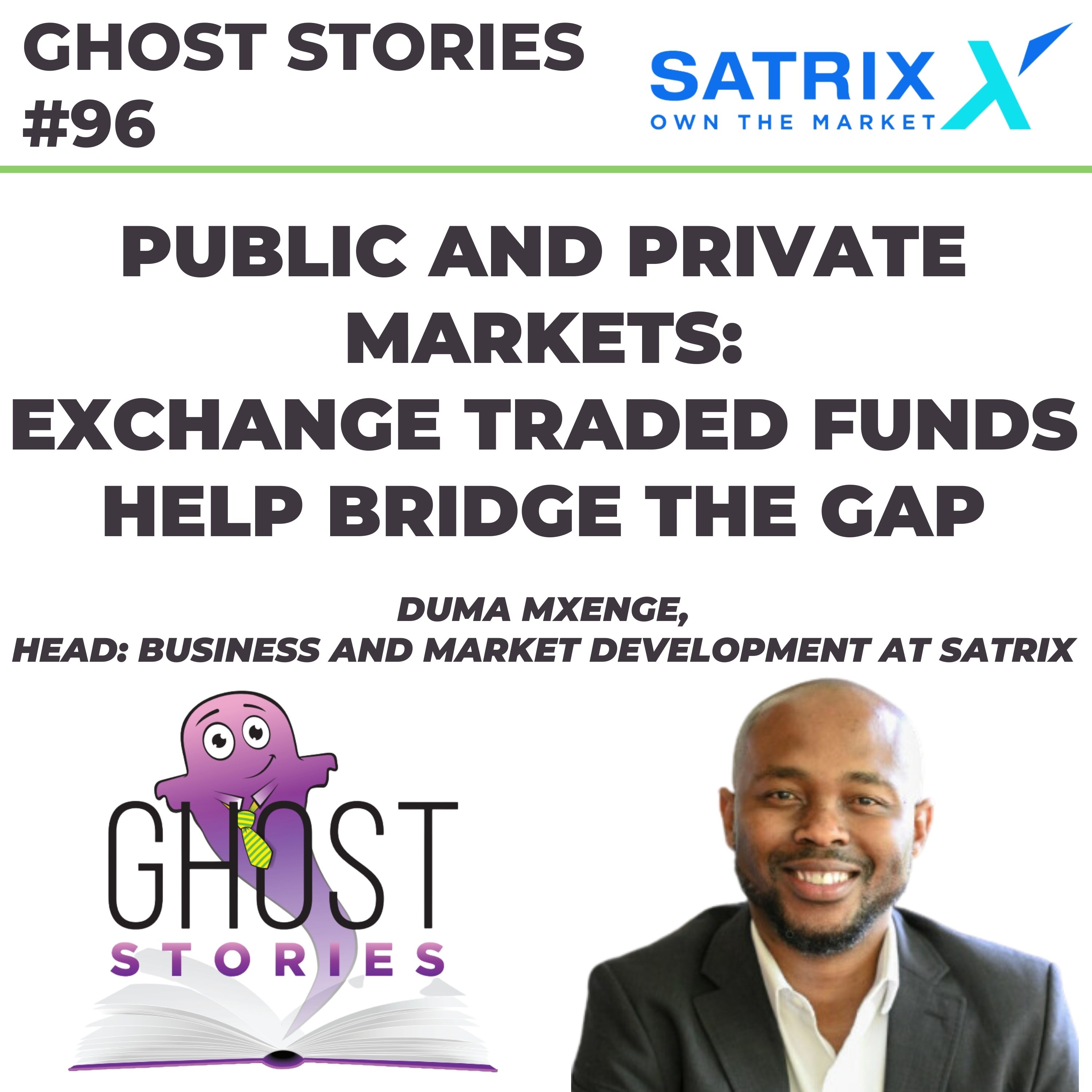
Welcome to this episode of the Ghost Stories podcast. It's going to be a particularly interesting look at a rather technical application of a structure that I think we all know and certainly love, and that is exchange traded funds. That's something where if you don't have them in your portfolio, you really need to take a good hard look at what you're doing and make some changes, I think, because ETFs are a fantastic underpinning any equity portfolio. And you can go back and check out any of the podcasts that I've done with Satrix over literally the past three years. There's a wonderful library of content there for you to go and understand why these things are so important. And of course you can also have them in your tax free savings account, something that is a really, really useful way to build wealth over time.
But today we're talking about something a little bit different. Another application for exchange traded funds and I think a fascinating look at some financial engineering concepts and how things can be adapted. So to do that today, Duma Mkhrenga is here and he is going to walk us through exchange traded funds and how these can be used in the private markets. So Duma, I'm really looking forward to this very interesting stuff.
[00:01:25] Speaker B: Thank you guys and thank you for having me. I know I promised last year that I'll come back with the stock pick, but geez, I mean this market is no stock pick. So I thought I'll come with an interesting topic.
[00:01:36] Speaker A: No, exactly. Now look, rather this than throwing darts at stock picks right now because the geopolitics changes literally every three hours, let alone the time between recording and release and someone listening to this down the line. So we'll stick to our knitting today, which is literally ETFs in private markets. So I think let's jump straight into that. And obviously what makes this interesting is if you just look at what ETFs do and what they say they do. It's an exchange traded fund fund, it's a listed instrument. So people immediately think index tracking, liquidity. I mean these are the key characteristics, right? I think let's just start there. If I think through the Satrix product suite, when people think ETFs, they are thinking diversified, one shot, underlying basket and listed, right?
[00:02:15] Speaker B: Yeah, I mean, that's quite correct. At the core, as you said, an ETF is designed for simplicity, transparency and liquidity. They're listed on the exchange and everyone knows that you can buy and sell them throughout the day, just like a stock. And so, you know, for the last 25 years, and we celebrated our 25th birthday last year, is that Satrix has launched the very first ETF in South Africa. And I mean, from the work that we've done in the last 25 years, that the industry has now defined ETF by the idea of providing broad market access in a low cost and efficient way. And you will remember when we started, the world was sort of caught up with, you know, active versus passive. And I think now I'm quite glad to see that we have moved to a more sophisticated approach where it's actually active and passive. And so where the ETF form a core, as you said, world diversified portfolio, and you get to own the market, not just a few stocks and you know exactly what you own at any given time.
[00:03:06] Speaker A: Duma, that certainly does make sense. And that's my understanding of ETFs. I think if you stop someone in the street, well, maybe not in the streets, I like to think they'll know what an ETF is, but I think we maybe slept more work to do in that space. But certainly if you stop someone who knows something about markets, they'll tell you that about ETFs. But earlier this year in Ghostmail, you wrote an article about private markets. And I must say, I. It's not often that I receive a piece of content where I'm like, wow, you know, I've really learned something from scratch here. But I had no idea that ETFs were finding some application in private markets. So that is really interesting because private markets are typically defined by lack of liquidity, lack of visible pricing. I mean, one of the main roles in public markets is price discovery, which just means willing buyers and sellers fighting it out every day to see which direction a share price goes, or any other price, really. You don't get that in private markets. But on the plus side, there's a gigantic variety of assets available out there in the private space. And certainly the trend we've seen in recent years on stock exchanges, not just in South Africa, but around the world, I think the US has somewhat bucked the trend. But that's really the only one is more companies are choosing to stay private and change hands in the private space rather than actually coming to market and doing an IPO and going through that regulatory process. So there's a lot of opportunity in the private space.
And this is not an easy place for institutional investors to participate for a variety of reasons. So I think let's maybe deal with that. What stops institutional investors from getting involved there? You know, what are the challenges?
[00:04:30] Speaker B: Look, I think you've articulated the challenge quite well. I think for the benefit of the broader audience, when we talk about private market, one can think of private equity, private credit or debt infrastructure projects in some cases, how they get wrapped, it's either infrastructure debt or it's infrastructure equity. And there's also direct property. And so these private market strategies, essentially what they're offering, which is the point that you're making, is they're providing a direct access to up to 80% of the economy in job creation. This is where the real growth occurs. And as you said, more and more innovative companies are choosing to stay private for longer, which is a shame for the public market. However, for institutional investors, especially pension funds, there are other significant challenges that I just want to highlight to you pertaining to private markets. One is operational complexity. Investing in direct markets require extensive due diligence. I mean, you can imagine the legwork, you know, the ongoing management is not as simple as buying a share on the jsc. What we've just articulated with the ETF and the second big one is liquidity. And I'm sure we're going to come back to this, is when you invest in private companies, your capital is locked up for a number of years, especially in private equity strategies. And pension fund need to manage the liquidity carefully to pay out benefits to members so they can't afford to have too much of their portfolio in liquid asset. And the other most important point is the governance challenges. So trustees and principal officers of pension funds have a fiduciary duty to members. And the lack of pricing and day valuation of private markets make it difficult for these governance obligations. So Even though regulation 28 allows pension fund to have a meaningful allocation to private markets, for example, private equity, the maximum is 15%. The reality is that it's far, far lower than that. And so they're missing out on what you've just described. The diversification, the growth opportunities that private markets offer, especially as the public market, the jsc, has been shrinking. I mean, we saw CURO and also saw Bala World delisting from the jsc, which is quite a pity. So private market is becoming more and more of an important component in terms of having exposure in your portfolio.
[00:06:33] Speaker A: No, it absolutely is. And obviously we'll get to the role that ETFs can play in this space. And ETFs are definitely not the silver bullet here that will solve all these problems.
[00:06:40] Speaker B: Sure.
[00:06:41] Speaker A: But one thing that I want to touch on, that you've mentioned there, which is really interesting, is this concept of due diligence and actually doing the research in these companies. And for listeners, I just want to distinguish between doing the research in public listed companies and what it means in private markets. Because of course, if you're going to go and buy single stocks on the JSE or any other market, which basically means a company as opposed to a big diversified basket of stuff in an etf, then you still need to go and do the research, you still need to go and read the financials, you need to understand what you're doing. But the difference in a private company is, number one, the level of trust that you have in the underlying data, because it's not necessarily gone through a big audit process and big finance teams, etc. So there's always risk of information asymmetry there, where the seller of the business knows more than you do as the buyer, even worse than it is in public companies. But even more than that, it's because you don't have the benefit of listing rules set in this kind of minimum standard around disclosure, governance, how the company behaves, etc. So the private markets then tend to be riskier and obviously it's a risk specific spectrum. There are a lot of private companies in South Africa and everywhere in the world that could be very large listed companies. They're just choosing not to. And I'll give you a great example. Lego is a private company. I don't think anyone would hesitate to own a sharing Lego if they were given an opportunity to do so at a half decent valuation. But it's just not a company that is ever listed. So private doesn't mean small, obscure and weird. It literally just means unlisted.
And if you play in the bigger unlisted, then a lot of the risk factors that come in with those smaller companies and the due diligence type stuff, you are managing those risk factors in a way that is acceptable to institutional investors. So I just wanted to highlight that kind of differential there. And speaking of institutional investors, I know you're speaking to them all the time and when stuff like this happens and you kind of come with ideas like, well, how can we use ETFs in private markets? I always wonder if this is something that came through in Conversations with institutions where you went for coffee and they said to you do my. You know what we would love? We would just love it if you came up with a way to use ETFs to do this. Or is it the Satrix team sitting around and coming up with these cool ideas and then going to the Instos and saying, hey, we have something interesting to show you today?
[00:08:49] Speaker B: I guess it's a combination of both. It's important to listen to clients. I mean, we've had conversation with institutional investors, not necessarily coming up with the solution. I mean, just listening to them in terms of what I've just described, in terms of the challenges, that's one thing. And also from their vantage point, you've cited Lego. There's definitely great concern with the shrinking of the public market and they know that they need to have access to private markets because they deliver long term returns. But they held back, as I said, with the challenges that we've just discussed. At the same time, one guy once said it's important to look at global players in terms of what they're doing and if they're doing some interesting things, there's nothing wrong in being a great copier. So we do look at global trends and we see your leading global asset managers are also moving in the direction of actually providing private markets to institutional clients. That being said, I mean, even our group CEO, Paul and Ratty has identified this as a key strategic priority for Sunlam. And in fact, he advocates that pension funds should have a meaningful allocation to private markets up to 30%. So the solution is really born out of clear client need and also a strategic view of where the investment world is heading.
[00:09:54] Speaker A: I'll give you some other examples of really interesting private companies because again, I just want to land this point of how big some of these things are. So Rolex is another serious company and that's privately held. I mean, it's Swiss. You'd expect it to be as private as possible. So Rolex is there. Bosch is another one. All the obviously industrial equipment and tools and DIY and lots of other stuff and lots of automotive applications, et cetera. So again, some really, really interesting assets out there that are otherwise quite difficult to get access to if there isn't some kind of mechanism to actually achieve that. So I think let's dig into the way in which you believe that ETFs can start to actually address this. And I'm particularly keen to understand where it can address these challenges and which challenges simply can't be fixed by just using an ETF because it obviously, as I said, can't fix everything. Liquidity is the one that comes to mind first and foremost, because that is the single biggest difference between private markets and public markets, I would say, is liquidity. The ETF itself tends to be tradable, but that doesn't mean that the underlying assets are suddenly liquid right in the private market space, as opposed to public market space. So how does this work in terms of liquidity and rebalancing and all the stuff that we understand when people say etf?
[00:11:03] Speaker B: That's the million dollar question. And that's exactly what we are trying to address and make our clients understand in terms of the role of the etf. So I think it's key to understand that we are not trying to create a liquid version of a liquid asset. And it's important to repeat that we are not trying to create a liquid version of any liquid asset. I mean, that's impossible.
Instead, what we are advocating is that we are using a liquid ETF as a liquidity sleeve to manage the overall allocation of a private market. So let me give you like an example in terms of how it works practically, let's say a pension fund commits, let's say 15% of the portfolio to a private market strategy. So let's use numbers. The total size of a pension fund is 20 billion. They allocate 15% to private market strategies, so that comes up to 3 billion. So essentially they ring fence the 3 billion towards private market strategies. And as you know, the money isn't invested from day one. It gets called by the private managers over several years. In the meantime, the pension fund can use the low cost liquid ETF to keep the capital invested and align it with the long term strategy. So when the capital call comes, they can sell a portion of the ETF to fund these capital calls. The ETF also provides liquidity needed to manage the members in and outflows. And remember, the pension fund is quite dynamic. So without actually disrupting the long term illiquid private investments. And this is where a lot of the private market managers get annoyed. All of a sudden they want to deploy and there's issues around liquidity of the overall front. So that's what we are trying to manage. And it's about managing the transition as well as the liquidity around the private market allocation and not trying to make the private assets themselves liquid. You also mentioned rebalancing. So imagine you've got this 85 public and 15% private market and the public market runs. Now all of a sudden the mix is like 9010. So again, the liquidity sleeve, you can actually now allocate 5% to the private market allocation in order to get that balance right. And that investment or cash can actually go towards this liquidity sleeve or the etf.
[00:13:05] Speaker A: Okay, Dumas, so let's maybe understand that by just digging deeper into an example then to make sure that firstly, I get it and that everyone listening to this gets it. So what would typically happen in private equity land is you would have a fund manager or a promoter of some description who would go and say, well, I'm going to go and find a group of interesting private assets and going to put them all together. Let's use me as an example. The finance ghost. Nowhere near as exciting as Lego or Bosch or Rolex, but I think it's cool and maybe other people would think it's cool. And so you bunch that together with some other upcoming media assets and you call it alternative disruptive media or whatever else, come up with a lovely presentation and go and present that to institutional investors and you hope to get them around the table and agree to some kind of investment.
Now, that is a complicated thing. And what this ETF is not doing is replacing that investment vehicle. This ETF is not saying, okay, this is the alternative disruptive media etf and the underlying is all these assets. And this is a wonderful way to get around the challenges of shareholders agreements and everything else. That's not what this is, what this is saying. If I understand correctly, this ETF is almost like a placeholder that basically allows for investment in diversified assets in a ring fence structure where the person putting together this group of media assets knows that they have access to the capital.
So they can actually go and make the capital call and say, you know, hello, it's time to put your money in. And on the other side, the institution knows, yes, that's fine, because that money is already somewhere. It's somewhere that is compliant with all our rigs, it is sitting in assets, it's in an ETF and it's liquid and it's ready to go. It's like a bespoke ETF almost. Is that then like per institution? Is it just one big ETF where all the institutions then own that placeholder?
[00:14:49] Speaker B: It's per institution, so it's per pension fund. Each pension fund has their own strategy because in terms of how they're going to allocate or how they think about their design for private markets, it's different from pension fund to pension fund. So the ETF will be Tailored for whatever that strategy or long term return that they have in mind. So we try and mimic that.
[00:15:05] Speaker A: Okay, got it. So if anyone was listening to this and planning how they were going to go and piece together an interesting group of private assets and then raise the money through an etf, unfortunately that's not what this is. This is actually, if I understand correctly, Duma, this is more of a solution for the institutions.
You can actually then use this to manage it. So that makes sense. And then it's an ETF per institution. It's the sunlam. One day we will invest this ETF and it sits there and it makes sure that the capital is there. What are the underlying assets in it? I guess it depends on what the institution wants. Right. It would be put together on a bespoke basis.
[00:15:36] Speaker B: The beautiful thing about an ETF is the transparency. So an ETF portion of the portfolio provides the daily holdings in terms of disclosure. So it gives the trustees as well as the investment committee a clear and a retire view of the significant part of the allocation, which is this liquidity sleeve. It provides a level of transparency. There's governance comfort because they've seen it before. It makes it easier to manage the more peg side of the private market investment. So by using a highly transparent regulated and a liquid vehicle to manage the allocation, you solve many of the governance headaches associated with private market. It also allows the fiduciary to focus the governance budget and attention on the private assets, knowing that the public side is taken care of, which is the ETF liquidity sleeve that I referred to.
[00:16:19] Speaker A: And of course ETFs are known for being low cost structures and here it's very different. This is essentially a temporary place to park your money. Although I guess if you're doing it per institution on a bespoke basis, you'll basically get the structure in place and then it will just last into perpetuity as where they park their money before they go and invest it. Right. This is almost like the personal finance analogy is like your money market fund. Yeah, I don't want to say it's your emergency fund. It's almost like your mid duration kind of money on call where I don't need it right now and I probably don't need it a month from now, but I might need it three months from now. And that's essentially what this thing actually is. But because of the highly regulated environment for institutions, it's a lot more complicated in terms of where the money needs to sit. And again, this is not just an institutional solution in terms of the lens of the institution. It also gives the company, the entrepreneurs, the promoter, whatever raising the money, comfort that the money is actually there. Like that's a big part of this, right? That the capital call is there and they don't need to worry about any potential hiccups down the line.
[00:17:16] Speaker B: Exactly. And also the Corey is, or a pension fund, you don't want to have a situation where 15% of your allocation sitting in cash because then you're not sweating the assets. So what we are saying is that by using the ETF as a liquidity sleeve, you're trying to sweat those assets so that you are always invested in the market. But it's liquid instruments that you can call at any time as and when you need it.
[00:17:35] Speaker A: And obviously it's the investment committee's job to then make sure they don't do crazy things like, I don't know, go and put it in risky equities where there could be a market crash just before their capital call. I mean, those are all the checks and balances that would need to happen internally with a product like this, Right?
[00:17:48] Speaker B: Correct.
[00:17:49] Speaker A: That makes sense. And of course ETFs are very famous for being low cost structures. So I guess in this case it's not about, oh, long term. Well, I guess it is long term investment returns because again, it's about managing the cash drag, etc. So I guess the low cost nature of ETFs carries through into this product as well, which is quite important. Is that possible in this environment, just given how different this is?
[00:18:11] Speaker B: First things first, I mean, it's important to just highlight that, you know, private market investment do come with high fees than your traditional public investments. So there's no getting around it. You know, if you speak to any private market manager, the term that they use is origination premium. So there's a premium attached to creating and originating quality assets. However, the goal with this having a hybrid structure of the ETF with the private asset is that you are able to manage your TIC or your total investment charge. So by using a low cost ETF for the liquidity portion of the portfolio, you create a blended fee that is much more palatable for an institutional investor. So the ETF helps to subsidize the cost of the private market allocation, making it more accessible. And the key metric that a lot of private market managers use is this net return after fee, or the technical term is excess return per unit of risk after fees. And evidence has shown, I mean, you've mentioned Lego, that historically private Markets have delivered superior returns that more than compensate for the higher fee that you pay.
[00:19:12] Speaker A: Yeah, I love that concept of an origination premium. I mean, so much of finance is about putting fancy terms to things that if just explained simply, are quite simple. Right. But that's how the market works and it's basically just a finders fee. Like it's not easy to find these private assets, it's even harder to get the owner of them to agree to sell.
[00:19:27] Speaker B: Absolutely.
[00:19:28] Speaker A: I mean, this is our private equity works. This is how the corporate finance industry works. I did this life for years. It's very hard. It's very, very hard. And it all comes down to origination premium. Yes. Getting paid to go do the things that you actually do. And there are fees involved in that. And of course, again, this is about managing for the institutions the parking fee as opposed to the structure further down, what the portfolio manager might earn. We've got to keep distinguishing between these concepts because of course it's kind of easy to get confused, I think, of where the ETF sits in this value chain because this is quite interesting and I think it's also very much through the lens of institutional investing. So institutional investors listening to this will go, oh, yes, this solves, you know, X, Y, Z problem that I've always had. Whereas I think for retail investors listening to this, you understand ETFs, it's like, hang on, what does this mean? Exactly?
So in terms of timing of this thing coming to the institutions, when is this coming to the market? And also is it targeting all institutions? Big, small, like, what sort of minimum size does this ETF need to be to be viable? Because anyone listening to this going, oh, this might make sense for my particular investment fund, might want to just get a sense of size and timing here as opposed to just timing.
[00:20:35] Speaker B: That's a very good point. The direction of travel, when you look at innovative products is that you first start with pension funds because they've got the scale right. And then once you get that right and you've got the scale right, then you can start looking at more, not necessarily bespoke, but more off the shelf solutions. So you start looking at family offices, you start looking at addressing your network, individuals. And there are examples of that. You know, overseas, the likes of State street have partnered with Apollo, where you can actually buy an off the shelf ETF where 80% is liquid and 20% is actually private market, we're not there yet in South Africa. And then ultimately you can provide products like you've been used to with the ETFs in South Africa, no minimum, which then address the mass affluent. But for this particular fund, the initial focus is institutional investors and typically to create a bespoke portfolio, you're looking at a minimum of 100 million rands worth of assets. And also, you know, the pension funds are the ones who are more equipped to handle the complexities of a private market investing. That being said, the long term vision is absolutely to democratize the market. So we are socializing the idea with institutional investors and then we can start looking at the broader market, as it were.
[00:21:40] Speaker A: Yeah, it's interesting. So a lot of the conversation the past few years has been move away from the concept of active versus passive. It feels like some lines are now blurring between public and private, which is interesting. All I want to see Duma is just venture capital ETFs on the JSE. That's all I want you to do. I just want a low cost way for people to add some serious risk to their portfolio and for money to find its way into risky places. You know, it sounds crazy, but the American market is built around this. The American economy is built around this, which is people taking serious risk. It sounds ridiculous, but if you're willing to go and throw a thousand rand at online betting, and clearly lots of people are willing to do that, then a thousand rand on an ETF that owns a basket of 20 VC type plays. I would argue that the odds are much better in the VC investment than they will be in your online betting. So, you know, it's slightly tongue in cheek, but at the end of the day, I wish there was like one thing that could change in South African finance. It would be a way to just bundle together VC assets into a low cost strategy with an appropriate amount of regulation that is as little as possible and to just YOLO it and just get some capital into the hands of entrepreneurs who are actually out there trying to do some cool stuff and to just get away from this thinking where investing is a very low risk thing. And then people take their money and they literally gamble it away. And we don't for some reason talk about how there's a risk spectrum where you can take that amount of risk on gambling, but it's an investment, you know. Anyway, that's my wish list. When we do this again next year, I'd love you to come back and tell me about how this is happening.
[00:23:11] Speaker B: No, I hear you. I mean the private market space is definitely exciting. It is something that we are looking at and also finding the right structures that make sense, but we also want to stick to what we are known and that is simplicity, transparency. So if we can find a sweet spot, it's a journey that we'll need to work with our private market colleagues to find products that are retail friendly, as it were. So we'll definitely put that in our to do list in terms of product development.
[00:23:35] Speaker A: There we go. Then we can maybe get that little basket of media assets into a VC fund. Imagine how fun that would be. Dima, on a serious I thank you. I think this has done a really good job of just clarifying the role that ETFs can play in these private markets, because I think even for me you kind of hear that and you think, oh, that's interesting. But you know, unlisted assets are liquid and blah blah. It's not trying to solve those things, at least not right now. What this is trying to do is give institutions a way to have less cash, drag a ring fenced amount sitting in a liquid asset that they can manage their cash calls and so that people looking to put together private structures have got a little bit more comfort that this money is actually there and it's ready to go. Very interesting. And obviously anyone listening to this who wants to chat to you about this can reach out to you on LinkedIn.
[00:24:16] Speaker B: As always, Duma, yes, most definitely. I'll be quite keen to unpack it. It is a new concept and there's a lot of learning that we can also learn in the industry, but we're super excited. I think there's definitely a space for such a solution.
[00:24:28] Speaker A: Fantastic. Duma, thank you so much and I'm sure we'll do another one of these soon this year. Good luck and I look forward to seeing how this all plays out.
[00:24:35] Speaker B: Thank you guys. I'll definitely give you an update.
[00:24:39] Speaker A: Satrix Investments Pty Ltd. And Satrix Managers RF Pty Ltd. Are authorised financial services providers. Nothing you have heard in this podcast should be construed as advice. Please do your own research and visit the Satrix website for more information on all their ETF products.