Episode Transcript
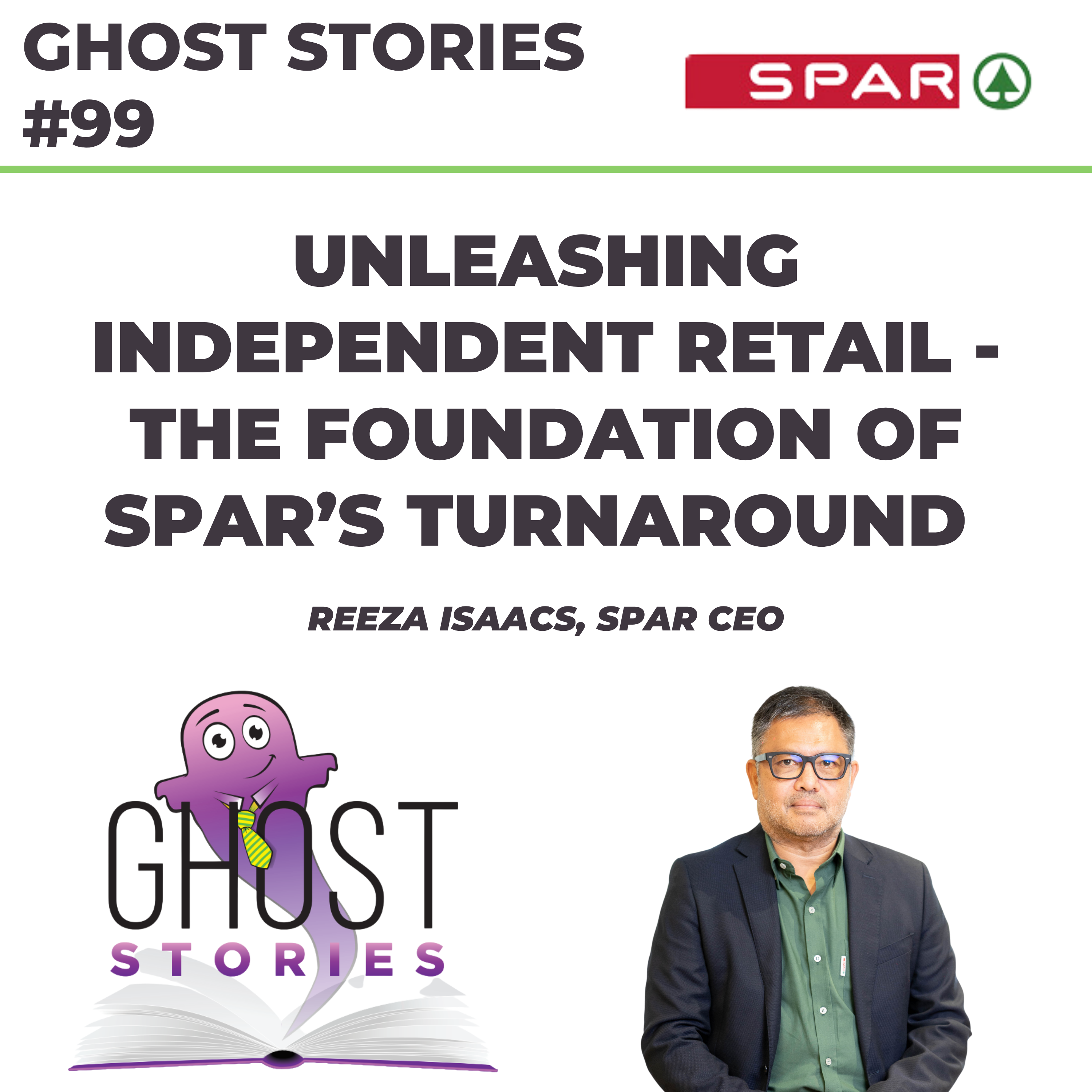
[00:00:00] Speaker A: Reza Isaacs is the new CEO of spa, and he is passionate about unleashing the power of independent retail. But he's also candid about the challenges that have been faced by the group and the things that they need to get right. He joined me on this Ghost Stories podcast to explain the foundation for SPAR's turnaround and how they believe they can grow and improve from here. This podcast has been sponsored by spa, but I was, of course, as always, allowed to ask whatever questions I wanted to.
Welcome to this episode of the Ghost Stories podcast. I'm your host, the Finance Ghost. I'm here today with Reza Isaacs. He's moving from the CFO role to the CEO role at spa. Really interesting and a very important company. I think I've said this a few times before in ghost mail, but I have these very strong childhood memories of going to my local SPA with my mom after school. I think it's a company that just sits at the fabric of the South African consumer, and it certainly has for a very, very long time.
So it's a big responsibility and it's obviously a group that has been through
[00:00:56] Speaker B: some very tough times in recent years.
[00:00:57] Speaker A: Reza, you have bravely stepped up to take on that role. So congratulations.
[00:01:01] Speaker B: Let me just start there.
[00:01:02] Speaker A: Let me also say that I am a sparse shareholder, so I personally would love to see the share price go the other way, and hopefully it will. So, Reza, welcome to the show and thank you for doing this so early in your new role.
[00:01:13] Speaker C: Thank you very much.
[00:01:14] Speaker A: So we're going to deal with some really nice, meaty topics today, which I'm obviously looking forward to. And we're going to run through a variety of things, like just start with the most obvious one, which is the management changes. In recent years, there have been a few of them, and from an investor perspective, what everyone loves to see is executives who are there for a long time and have a chance to actually roll out a strategy over several years. Because I don't think anyone is under any illusions that it's quick, just walk in and wave a magic wand and turn the place around. That is not how the real world actually works. So I think management commitment, having you there for a long time, being these are quite important factors. Let's perhaps just start there. From your perspective, you've taken this role. It's clearly a hard job. Give us some thoughts around your commitment to this, why you've done it, how long you see yourself there for. I think investors will want to know that it's going to be you on the other side of this call for a while.
[00:02:02] Speaker C: So maybe just a bit of background. I'm a CA. I did my articles at EY. I spent 20 years at EY. I left as the managing partner of the Western Cape region and one of my clients at the time was Woolworths and I left EY to join Woolworths as the FD. I spent 10 years at Woolworths, so my stints in corporate and professional services have not been short stints. If I take on a particular challenge, I like to see it through. I joined just as the David Jones acquisition was being made. It was an interesting ride. I decided to take a break after 10 years and after we disposed of David Jones and through that time we survived Covid.
It was in a way a very similar situation to the SPA group and we went from a situation of speculation around equity raise at the start of COVID to resolving our balance sheet issues, selling of David Jones, restructuring the debt and eventually buying our shares, 7.5% of our shares in issue in the year end of 2023. You know, the spa story is an interesting one. I also do like bit of a turnaround and underdog story and I think if you look at SPA had governance challenges, it's had operational challenges with SAP and of course from a finance perspective, it's had a balance sheet that needed restructuring. We needed to reduce debt. Very similar. We're not paying a dividend at the moment. I'd like to see it through. I'm not one to shirk responsibilities. I'd love to see SPA back at its rightful place in corporate South Africa and in the retail space. We owe it to our retailers, to our shareholders.
[00:03:35] Speaker A: Yeah, look, I wasn't joking at the beginning when I said it's a big responsibility. There are a lot of people who rely on the SPA business at various points in that chain and certainly a lot of franchisees who have invested in building out these stores and people who love shopping there. This is all stuff that I've written in Ghostmail many times and I stand by it. A very good SPA in my opinion is almost unbeatable as a shopping experience in grocery. I really do think it is peak. So thank you. That definitely does give some additional information around not just your level of commitment, but also the scars on your back in terms of offshore. Obviously that Woolworths David Jones deal is unfortunately the poster child for how to get it running when it comes to offshore acquisitions. I do think that South African investors have learned a lot. South African management teams have also learned a lot. And unfortunately SPA has had its own offshore challenges. So let's maybe just talk about that a little bit. Poland was surely the worst, Switzerland was not too far behind. But I was happy to see that there was a bit of an understanding of, look, your first loss is your best loss. Let's get out of Switzerland while we can. You're currently in the process of disposing of AWG, I.e. applebee, Westwood Group and the one that you're hanging onto. And this is maybe what's more interesting for me because I don't think opposed mortar on what went wrong is of
[00:04:45] Speaker B: much use to investors.
[00:04:46] Speaker A: The thing I'm interested in is the fact that you're hanging on to Ireland and there must be good reasons why you believe that that one is different to the others where you've either shut them down in a very painful way or you've tried to get out in time while it's not too bad. So I think let's deal with why you think Ireland is the one that actually makes sense to keep out of all of these offshore investments.
[00:05:04] Speaker C: It's a really good business. These positives and negatives for South African businesses owning offshore, probably more negatives in our own case. It's been Poland, it's been Switzerland. You know, at the moment we're obviously in the process or disposing of awg, but Ireland itself, it's a really good business. We've got a great team, it's a diversified business, it's got retail, it's got wholesale, it's food services, it delivers from a top line point of view, from a gross margin perspective, it manages costs really, really well. It provides an underpinning at the moment from a valuation point of view. And it's not just diversification in Ireland itself, also for the group there is risk diversification, obviously, SA macro. And while we stabilize the SA operations, it provides an underpin, doesn't require any funding, it's got sufficient headroom from a funding perspective. It also provides an example of a spa business and people talk about the model being relevant and being challenged, but it provides an example of spa business that we own that does really well. You know, how it supports its retailers, how it spots opportunities, how it grows, etc. Etc. I think on the negative side, I feel it's undervalued in terms of some of the parts. Certainly my intention would be to expose the business a little bit more to investors and get parts of that management team in front of investors and actually really talk to what the Ireland business is about. And what the prospects are. There's a significant market share in the convenience space in Ireland. And understand the arguments. If one wanted to invest in an Irish business, you wouldn't do it through a South African entity. The benefit to us, we're getting a dividend out of Ireland now they've committed to a dividend. It's self funding. There's no cross border, cross guarantee exposure. And it makes sense for us to
[00:06:45] Speaker B: hold on to it and maybe just in terms of business model, just help people understand.
[00:06:49] Speaker A: Is it similar to Southern Africa?
[00:06:51] Speaker B: Is it actually quite different?
[00:06:52] Speaker C: Yeah.
[00:06:53] Speaker B: In terms of how that Irish business is run. Just gives people a sense. Because I think, as you said, that business hasn't gotten a lot of attention in the local market from investors. I think there's just this offshore bucket for spa and people go, oh, that's horrible. Whereas actually there's one that you want
[00:07:06] Speaker C: to hand on to from a spa sort of business point of view, it's very similar. It is a wholesale business that supports independent retail where it is different. It doesn't just have the spa brand that it competes with in the market. It has R Mace, XL Gala and these actually compete with the spa brand in Ireland. But they know the demographic, their place in that market pretty well. It has other wholesale businesses as well, not just under the spa banner. And as I mentioned, it's got a food services arm as well, which utilizes the back end of food services to actually service quite big industries in Ireland. So geographically it covers Ireland pretty well. And as I said, diversification of earnings and business is quite well spread.
[00:07:51] Speaker B: Okay, thanks, Reza. That does at least give us some
[00:07:53] Speaker A: additional info then on Ireland. So thank you.
[00:07:56] Speaker B: And I guess the cheeky slash, maybe not cheeky question. As an investor and obviously someone who's just seen a lot of pain at spa around offshore, can we at least say that offshore deals, new offshore deals are not a focus area? I would hope, at least for the medium term, I kind of hope forever, but forever's a long time. So let me rather ask if at the very least we are done with this for the foreseeable future.
[00:08:19] Speaker C: Our focus at the moment is on the SA operations. It is stabilizing currently the foundation that we have from an operational perspective. It's exploiting currently what we have, our 2,000 sites now, a thousand retailers, making sure we support them. And then the third bucket would be growth, which is quite hard to come by in constrained economy. So our focus is very much on the South African business.
[00:08:43] Speaker A: So speaking of southern Africa, let's get into it you have a really strong business in southern Africa, but obviously it is dealing with a competitive onslaught at the moment. There are some real gorillas in the market. And my take on it, I guess my outside take on it is that if you go pre Covid, SPA always felt like the convenience default. Chances are good that there's a shopping center on your way home from work or school. There's probably a SPA there, it's a line shop, it's easy to park and in you go. And I always felt like that was spa's model. It wasn't necessarily somewhere where you might go and do your monthly grocery shopping. You, you could do your monthly grocery shopping there, but that wasn't really spa's key differentiator. You won't find SPA in big shopping centers where you need to go and park and walk and do a whole thing. That was always my take on it. And then what's obviously happened in a world of COVID and thereafter is stuff like online shopping and delivery, et cetera. And I want to ask about that separately. But I think before we get to that, we need to deal with what is essentially the underlying business model of spa. Because there is one very big thing that differentiates you from the other listed grocery players in South Africa and that is that SPA is a wholesaler, whereas the others, like Pick n Pay, are a mix. They've got franchise and corporate owned stores. Shoprite, they've only got OK as their franchise. The rest is corporate owned. And at Woolworths some years ago they went away from franchise, they bought up all their stores. So SPA is the odd one out. And I think the franchises are both a strength and a weakness. Personally, like most things in life, I'm keen to understand from your perspective how your franchisees are doing, because we know that Spar's wholesaler has been through a tough time. The actual stores themselves, how are they doing and why do you think that the franchise model can be a strength?
[00:10:17] Speaker C: Our independent retailers don't like to be called franchisees, so they are independent retailers. There's obviously a distinction between franchise and independent retail. And I just want to stress that our model is a voluntary trading model. So you sign up, there's an MRI that you agree to, but in the end it's voluntary. We do have fluctuating or differing levels of loyalty amongst retailers. Those can be influenced by geography, certain lines that they specialize in and they focus on. But on average we are about 80% loyalty. The way I simplistically think about it is that South Africa is a very diverse country in terms of the communities and the LSMs we have. Independent retail actually allows you the flexibility to service those communities in the best way that you can. The strength in the models, also the fact that we have a thousand independent retailers that we serve from a wholesale perspective, and these retailers are at the front line. They're in their communities. Whether it's in Sea Point or Rondebosch east or Khayelitsha or Langa, There's a core offering that we provide them. They adapt, I think about it as the remaining 20% to their particular communities.
They have the agility to adapt and to adapt quickly to really understand what's going on in their communities and to service those communities with exactly what they need. They do it to the best of the ability. The mindset of an entrepreneur and an owner is also different to that of a store manager, I think in that lies the strength of independent retail. There's been some stats published lately around the growth of independent retail versus formal retail, and there's still significant opportunity in that particular space.
Thousand retailers at the front line, 2000 sites. We focus on wholesale distribution and being as focused as we can. We manage a brand and they focus on looking after their communities and their stores. There are models around the world and we've got our own model in Spa island that works really well. And I think independent retail is thriving in Europe as well. The model does work.
[00:12:23] Speaker A: Yeah, the word community comes through a lot there, which is certainly my view on how a spa tends to do well. Independent retailers noted instead of franchisees. Fair enough. Maybe when that loyalty comes up closer to 100%, they'll feel a bit differently. We can only hope, hey, one day, cheekiness aside, let's talk about the downside then of what I will now call independent retail. And that is essentially, at least my perception of it. And I think what the stats are telling us as well, that is around online, and obviously this is where a group like shoprite has done exceptionally well. I think Woolworths has done quite well there as well. Pick NP certainly fighting them on that. It just feels like those three are having the battle of the scooters at the moment. And look, I could be wrong, but I haven't seen too many Spa2U vehicles on the road, if I'm honest. And I live quite close to a spa. So I've kind of always taken that as a sign that it's not an easy thing. And I guess that's the downside of this independent model. In order to do online you need this data engine at the center. You need a fulfillment layer and engine on top of just very hard to do that in a more disparate system. So sometimes a business model, it has pros, but that means it also has cons that are really hard to get past.
Is that the reality with online? Do spa investors like me need to just accept that maybe online is a battleground that SPY is probably not going to win? You might participate, but you're not necessarily going to be a big player there? Or do you have strategies where you believe that actually you can play catch up in terms of having this army of scooters or other vehicles on the road?
[00:13:50] Speaker C: Yeah. The spa is a different business model compared to full blown retailer like a Woolworths and a Chequers. Our model is about sustainable adoption of concepts like online and on demand. Typically, a retailer would look at a node, will look at how it tackles that particular node from an online and on demand perspective. And retailers are at the front end. For them, it's about sustainable adoption. So when the retailers are confident in the economics, they must be confident in delivering a service that customers trust. It's not our intent and we're not trying to be the biggest online delivery service, but we're trying to build a platform that complements in store convenience on a store by store basis, depending on the retailer. We have done a lot of work at the front. It's a little bit more complicated because some of the strength that we have in bespoke store offerings has to be replicated on the app. So your catalogs have to be adapted effectively by store and then of course the retailer has to adopt it. Our approach is highly targeted. Our growth has been good from a low base in 2022 and we now at just over 600 stores. On demand remains very important to us at a retail level. If you look at our like for like sales, we are, and this is not numbers to shout about, but we are just under 2% at the retail level, which means that on a like for like basis we are competing with the likes of a shoprite, but we're not talking new stores and new store growth. And then we've introduced Uber Eats, another channel through which customers can get this far. They obviously choose to pay a bit of a premium on Uber, but that is a convenience premium. And we've actually seen that that growth has also been quite significant. And we now at over 550 stores and continuing to scale up, but our focus has been on that individual store, that individual retailer, making sure that it Makes sense for them and make sure that from a retail economics point of view, that makes sense.
[00:15:43] Speaker B: So, Reza, thanks.
[00:15:44] Speaker A: Obviously not an easy thing to try
[00:15:46] Speaker B: and turn around in terms of some
[00:15:48] Speaker A: of these trends, like online, et cetera.
[00:15:50] Speaker B: And it's a fair take to say that there are these intricacies of the spa model, some of which will get onto online, some of which won't, but at least you are participating there. And other convenience plays, as you say, like Uber eats, et cetera.
[00:16:00] Speaker A: It's going to become more and more
[00:16:02] Speaker B: of a thing going forward. I mean, even if I just look at my own peer group and how people are behaving, and I think it's even more digital the younger you get. So that's going to be an interesting thing to see spa deal with in years to come for sure. Let's move on then to the wholesale side of the business, which is ultimately, well, that's where you play, right? That's where you actually are in the value chain. So people forget this all the time. They read the spa results, they think about their local spa, and they forget that the thing you are buying when you invest in spa, the listed company, is the wholesale business. So first question I wanted to ask, and I believe you subsequently fulfilled this position initially, when I read your last set of results, you were talking about a managing director for the Southern African Grocery and Liquor cluster. Effectively, I believe you've now filled that role. I guess the question that I wondered, and you know, I am quite cynical at heart, so you'd have to forgive me, but it kind of feels like it almost puts another layer of management in there and almost takes the top execs a little bit further away from what might be happening in Southern Africa as the core, core business. So you've kind of already addressed the fact that you're not looking to do more offshore stuff, which I think all investors will be very happy about. It then begs the question, why the need for the multiple layers of management? It's obviously something you thought about and is worth digging into to just help investors understand why you've kind of taken that route.
[00:17:17] Speaker C: That is an important question. Just a reminder that not so long ago we actually did have a managing director of Groceries and Liquor. That position was filled by Max Oliver. And then when Max left, Angelo effectively did that job as well as group job. And just from a pure corporate structure point of view, just if you look at the layers and spans of control, it doesn't make sense not to fill that particular position. You've got your six MDs that report to you. You've got merchandise, you've got marketing, you've got logistics, you've got the retail operations, and that's just for groceries and liquor. We've got an island business, we've got a finance function, sustainability, governance. But build it. We've got all the other support functions, hr, chief marketing officer, et cetera, et cetera. Certainly, from my perspective, it's about creating the right level of focus and accountability in the business. I'm very pleased to say that we have fulfilled it internally from within the business. Jerome Jacobs, he's taken on the job. He was MD of North Rand Division. He spent a number of years in the business. He's gone from the Western Cape to Eastern Cape to South Rand to North Rand. He understands the marketing and merchandise functions very well. He's highly respected amongst his peers and he's got a very, very good relationship with retailers and very good credibility with retailers. So it is a very important position that requires lots of operational involvement and retailer exposure. I just want to repeat, it's not about being removed from the business. I attend groceries and liquor executive meetings, so does Megan. And we are executive fully invested in that business. We understand that the turnaround of that business is absolutely key to the turnaround of the group.
[00:18:58] Speaker B: That makes sense. Thank you for clarifying. That's really important.
[00:19:02] Speaker A: May as well deal then with one
[00:19:03] Speaker B: of the other elephants in the room, obviously, because it is, it is a tough story at the moment to spar and that is the SAP implementation, which was obviously, unfortunately, somewhat of a catastrophe. Woolworths might always wear that unwanted hat of David Jones as the poster child for Offshore. I'm worried that SPY is going to wear the SAP one as the poster child for systems catastrophes for a long time. Hopefully eventually people will forget when it's out the way. But it has been obviously really tough for the group. Even some lawsuits underway. So from an investor perspective, when something bad happens, the main thing you want to know is that it's not happening again or the lessons have been learned, or there's reasons to believe that this is now firmly in the past and doesn't matter, you know, hakuna matata style. So what level of comfort can we give investors that this is gone now and that you've learned from it and that the coming systems implementations and whatever else you need to do will not be a repeat performance of what we saw at that dce?
[00:20:02] Speaker C: Yeah, let's be candid about the SAP challenges. They were significant.
It created real disruption in one of our biggest biggest, biggest DCs. And the legal action is a reminder just of that disruption. I'm not going to comment on the legal action, but we are confident of our position with regard to that. The key now is execution. We've gone from a big bang approach initially to a more phase controlled, well governed approach and separating the different aspects of the implementation from finance to drop shipment to warehouse and the likes. And it is an absolutely very important implementation. It's been governed from the board all the way down into the organization. Megan is the ultimate executive tasked with it. Megan, being supported by Brett McDougal, our CIO. And CIO in this instance obviously is Chief information.
[00:20:52] Speaker B: Yes. Not Chief Investment Officer, right? Absolutely. Slightly different world to what a lot of finance listeners might be accustomed to.
[00:20:59] Speaker C: And then we have project steer codes that meet on a monthly basis. We look at the governance, like I said, we've got program assurance around the implementation, we monitor budgets and progress on a regular basis. From data integrity to user acceptance testing to systems integration testing. Those are all being looked at extremely carefully. I would even venture to say I hope the tech team doesn't take any offense to this, but in some instances I think we probably a little bit too cautious implementation point of view, but we're sure that we get it right and all Those milestones like GP, visibility at the category level, etc. Are being met and it impacts the business in a positive way.
[00:21:40] Speaker B: Okay, so obviously with the SAP stuff hopefully out of the way and out of the system from a KZN perspective certainly and some more projects to come, your big initiative has got to be to win back the loyalty of the KZN independent retailer base. What are you doing to achieve that? You've mentioned that you've got a new executive who's coming from a Southern Africa perspective. Grocery and liquor respected by the retailers. I think that is very important. I can understand given the SPA model, why you need someone in that role. Someone who's not necessarily caught up in a lot of the group exco type stuff and actually has the ability to really engage with the retailers. So how do you win back that loyalty? I mean, is it just a case of winning back trust and just making sure mistakes don't happen again? Is there more to it than that? How should investors think about that?
[00:22:26] Speaker C: Look, KZM is a really important and a crucial reason for us. The SAP disruption has been significant and as I mentioned, we still dealing with the fallout of the that the team is rebuilding trust every day through the interactions with the retailers, transparent communication, targeted investment in Logistics. We've reconstituted the team. We've got a new head of retail operations in place, very experienced individual, a new head of merchandise, he's come from Northrand, and a new head of finance. So there's still some challenges in KZN from a operational perspective, but we're working very, very closely with our retailers to get that service levels back up to where it was historically. Loyalty levels were below national levels and that is just given the particular dynamics in kzn. And we need to get that loyalty level up by at least another 300 basis points in KZN. And just to remind everyone that our DCS outside of KZN are actually performing really well. They're at the 80% average loyalty in South Africa.
So again, we talk about outliers and the bad news, but just a reminder, at its heart, we still have 80% loyalty in this group.
[00:23:36] Speaker B: Yeah, exactly. At the core of this thing is a business that deserves to do well and hopefully will in years to come.
[00:23:43] Speaker A: I think speaking of doing well, let's
[00:23:44] Speaker B: maybe deal then with some of the growth engines in the group as we start to move towards the end of the podcast. So there are some green shoots in your story. I know the pharmacy business, for example, is one of them. We've seen your major competitors are incubating businesses that have really got very little to do with groceries. So clothing is an example. Pet care seems to be a real battleground. There's a lot going on at Woolworths and shoprite specifically around that in the clothing space. Obviously pick and pay has been pretty strong historically and shoprite starting to take that fight to them. So there's a lot of stuff going on outside of just traditional grocery and liquor and the way that business works at spa. So let's maybe talk about some of these other growth engines.
[00:24:24] Speaker C: Yeah.
[00:24:24] Speaker B: And do you think you've got the bandwidth, bluntly to actually fight for market share because you've got a lot to focus on in the core business? I guess that's the reason I ask the question. There's a lot of work to do in your day to day stuff. Yeah, well that's obviously is another big part of your group. Do you have the ability to really win share in these spaces?
[00:24:41] Speaker C: I certainly believe that we do the adjacencies like pharmacy, like pets and then if you look at a category level, coffee wellness, the trends around these subsets of retail has been really good. So in a constrained economy, going after these particular areas and we will be targeted, we are not going to be Everything to everyone. And we are going to help retailers pick their battles very, very carefully. And we're going to rely on our core strength, which is wholesale, which is distribution, and do it in these particular subsectors which will enable retailers to grow the pet business. We've got pet shop science in checkers, we've got absolute pets in woolies. It was a massive trend post Covid. There are good subsectors. There's quite a bit of formalization to happen in that particular space. The pharmacy space is very, very competitive. But there is a role, like there's a role for independent retailers. There's still a role for independent pharmacy businesses and we can support those businesses in their growth ambitions.
[00:25:38] Speaker B: So Reza, maybe just the final point then that I think is worth just touching on is really just for investors listening to this. I guess the story is do they believe that things can just be steady? Nothing can turn around until it's actually steady. And I do think that the worst is behind the business. There's been through so many challenges at spa. It feels like at some point, you know, it just will run out of huge problems and I like to think that it's there. I guess the question then is just moving the needle and the big initiatives. So if you wanted to leave investors maybe with a, not necessarily an elevator pitch, but maybe just the key points that you really want them to take out of this in terms of where you believe the story can go, the good news story of spa, I mean you've spoken to the extent to which there's a good business underneath all of this and I agree with that. I do think that SPA's market position remains interesting and at least it's differentiated with all these independent retailers. That's always been my take on it, is that there's something about spa's business that feels like it can compete. But in your own words, from an investor perspective, what would you want people to really just think about when they think about spa?
[00:26:41] Speaker C: Right now? The strategy remains, the foundation is solid. Unleashing the power of independent retail is still our core focus. We've scored quite a few own goals and SPA at the moment is a self help story to a large extent. To improve margin, we've set out nine particular initiatives that we are tackling and they are all very much within our control to achieve. Whether it's reducing corporate store losses, turning around our KZN distribution center, to reducing costs, to expanding brand label, these are all things well within our control. And we are at the heart at retail. We are 140 billion rand business, the second biggest retail business in the country. We've got to simplify the way we operate, got to get back down to basics, get our core purpose, I guess, in life, which is to service those retailers as best we can and simplify the way we operate and have clear, measurable KPIs and improve the business and just focus on execution. We are moving ahead. It might not be evident from some of the headlines that you see and that you read, but underlying all of this, and we've spoken about this a lot today, but a really good business with really committed retailers that's focused on growth and improving our market position.
[00:27:56] Speaker B: Reza, thank you. I appreciate you doing this so early in your new role because obviously your feet are barely even under the table from a CEO perspective. I think it was a pretty unexpected change of management for probably the whole group, not just the outside world. So thank you for being willing to do this and I guess I just wanted to wish you luck and all the best. As I said at the start, there's a lot of people who depend on the story and it is very much about just getting the basics right. No swashbuckling, fancy deals or anything of the sort. Just actually getting to the grind. Right. Because that's what retail is at its absolute core at game of inches. So I just wanted to wish you luck and the market will obviously be watching this one very closely. I'll disclose once more, in case anyone missed it at the beginning, that I do. In addition to doing this for Ghostmail, I do also happen to have SPA shares, a very small position in my overall portfolio. Like pretty much all my positions, I like a lot of diversification. Important to disclose that. And Ariza, thank you. I hope we'll do some more of these in future and good luck to you.
[00:28:53] Speaker C: Thank you for having me.
[00:28:54] Speaker B: Ghost, please remember to always do your
[00:28:57] Speaker A: own research as part of any investment decision in SPA or any other company and treat this podcast as merely part of your research process.